
LOADING VALMAUK
A mechanics-first guide to fixing your aim in Valorant: head-level crosshair placement, why you must be fully stopped to be accurate, counter-strafing, first-shot accuracy, when to tap, burst or spray the Vandal and Phantom, and a warmup routine that actually transfers.
By Mauk HK
Aim in Valorant is not raw mouse talent. It is a stack of habits layered on top of the game's very strict shooting model. Riot built Valorant around the same first-bullet philosophy as Counter-Strike: standing still and tapping is rewarded, moving and spraying is punished. If your aim feels inconsistent, the cause is almost never your hand. It is usually crosshair placement, moving while shooting, or fighting the wrong fight. This guide fixes those in order of impact, so you spend your practice time on the things that move the needle.
Read it as a checklist. Each section is a concrete change you can apply in your next game, not a vibe. Get crosshair placement right and you will win duels before you even consciously aim; get your movement discipline right and the bullets you do fire will actually land where the crosshair sits.
The single biggest fix for most players is not "aim faster." It is "place your crosshair at head level and pre-aim the angle." Good placement turns a flick into a click. If you only change one thing after reading this, change that.
Crosshair placement means keeping your aim where an enemy's head will appear, before they appear, so the shot is a tiny adjustment rather than a full flick. Two rules cover almost every situation. First, keep the crosshair at head level for the distance you are looking at. Most kills in Valorant happen at standing head height, so resting your crosshair on the floor or on chest height of a far box guarantees a vertical correction under pressure. Second, hug the angle: pre-aim the exact pixel an enemy will peek from, holding the crosshair tight to the corner rather than floating in open space.
As you walk through a site, your crosshair should "snap" from pre-aim spot to pre-aim spot, the lip of a doorway, the edge of a box, the top of a stairwell, never drifting lazily across dead wall. This is mechanical but it is mostly a discipline of attention. Most "I got out-aimed" deaths are actually "my crosshair was 40 pixels and 200ms away from their head when they peeked." Fix the starting position and you remove the flick entirely.
This is the rule that separates Valorant from arcade shooters. Every rifle and pistol carries a movement error penalty: while you are moving, your shots fly in a wide random cone, even with the crosshair dead on the head. Walking is more accurate than running but still inaccurate; only when your character has come to a complete stop does the cone collapse and the bullet go where you aim. There is no "good enough." Moving even slightly throws first shots wildly. The crosshair lies to you while you move; it points at the head, but the bullet does not follow.
The practical consequence: you cannot shoot accurately while strafing to peek. You either stop, then shoot, or you shoot first-bullet accurate only once velocity hits zero. This is why every good player stops moving the instant before they fire. The good news is that stopping in Valorant can be made nearly instant with counter-strafing.
Mental model: in Valorant the crosshair shows where you are AIMING, not where the bullet GOES. Velocity decides whether those two are the same point. Zero velocity = they match. Any velocity = a random cone. Your whole job in a gunfight is to be at zero velocity at the exact moment you click.
Counter-strafing is how you stop moving in a single frame instead of letting your character coast to a halt. Because movement in Valorant has momentum, releasing a strafe key leaves you sliding (and inaccurate) for a moment. To kill that momentum instantly, tap the opposite direction key: if you are strafing right with D, press A for a split second the moment you want to shoot. Your character snaps to a dead stop, your accuracy resets, and your first shot is fully accurate. Accuracy resets at the instant your movement changes direction, so the cleanest shot is fired exactly on that counter-tap.
When you are fully stopped, your first shot still is not perfectly to-the-pixel. Each weapon has a first-bullet inaccuracy value that defines a small cone. Rifles are tight enough that at most ranges this does not matter, but it is why two players can both "hit" a flick and only one connects. The Phantom has slightly better first-bullet accuracy than the Vandal, which makes it a touch more forgiving on a snap shot, while the Vandal's appeal is its flat damage. It kills with one headshot at any range, where the Phantom's headshot damage falls off at distance.
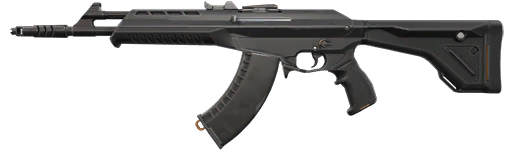
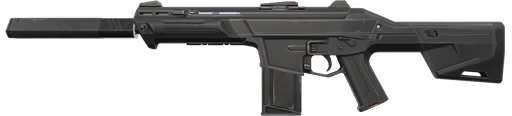
Your fire mode should match the range. The error stacks: the longer you hold the trigger, the more the recoil and per-bullet firing error open the cone, so distance demands restraint.
The player who initiates the peek sees their opponent a few milliseconds before the holding player sees them, because of how your own movement and network timing render the swing. This "peeker's advantage" means a wide swing can win even against a pre-aimed defender, but only if you are the one moving and shooting with intent. The counter is to not hold wide-open angles passively: hold tight angles so a peeker has less of you exposed, or "shoulder peek" to bait the holder's shot and then re-peek on your terms.
Peeker's advantage rewards aggression, but it does not cancel the movement rule. You still have to stop to land the shot. A wide swing that never plants its feet just feeds. Swing, counter-strafe, click.
Warming up is not optional. Cold aim is measurably worse, and the first two rounds of a ranked game are not the place to find your timing. A focused 15-20 minutes before you queue builds both the muscle memory and the in-game habits. Keep it varied: pure aim trainers sharpen the mechanic, but in-game modes train the placement and movement habits that actually decide rounds.
The biggest gap between good and great is not highlight flicks. It is doing the boring fundamentals every single round. Consistent head-level placement, consistent counter-strafing, consistent fire mode for the range. Flashy 180 flicks feel great but they are low-percentage; the player who simply always pre-aims and always stops to shoot wins more rounds over a season.
Sensitivity discipline is part of that. Pick a sensitivity that lets you do a 180 with about one comfortable swipe of your mousepad, write down your eDPI (DPI multiplied by in-game sens), and then stop changing it. Pros sit in a fairly narrow eDPI band, roughly 200-400, for a reason: lower sens gives the micro-control that head-level tapping needs. Constantly tweaking your sens resets your muscle memory to zero every time. Lock it in and let the reps accumulate.
"Aim is a habit, not a talent. The crosshair was already on the head. You just have to be standing still when you click.
Put the pieces together and the formula is simple: crosshair at head level, pre-aimed on the angle, feet planted with a counter-strafe, fire mode matched to the range. None of it requires elite reflexes. It requires doing the unglamorous thing the same way every round, which is exactly why it works.